

What Is a Pneumatic Grease Pump?
A pneumatic grease pump is an air-powered lubrication pump designed to transfer grease from a container to a grease gun, hose reel, lubrication line, machine bearing, centralized lubrication system, or other lubrication point. Instead of requiring the operator to manually pump grease, the unit uses compressed air as its driving force. This makes it especially useful when lubrication must be performed repeatedly, over long distances, or at multiple points during industrial maintenance.
Grease is much thicker than oil, which means it cannot always be moved efficiently with equipment intended for low-viscosity liquids. A pneumatic grease pump is built with a pumping mechanism capable of handling this higher resistance. Depending on the design, the pump may be mounted directly on a grease drum, installed on a mobile trolley, connected to a follower plate, or integrated into a fixed lubrication station.
Typical users include automotive workshops, truck maintenance facilities, heavy-equipment service centers, manufacturing plants, mining operations, agricultural machinery service teams, steel plants, assembly facilities, and maintenance departments responsible for bearings, joints, bushings, gears, and other mechanical components that require regular grease lubrication.
In simple terms: a pneumatic grease pump converts compressed-air energy into mechanical pumping force so thick grease can be transferred efficiently and consistently.
Why Is a Pneumatic Grease Pump Needed?
Manual lubrication is practical for small jobs, but it becomes inefficient when a maintenance team must lubricate many machines, use large grease containers, or deliver grease through long hoses. A pneumatic grease pump improves productivity by reducing the amount of physical effort required to move lubricant and by providing more consistent grease delivery.
1. High-Frequency Lubrication Work
In a busy workshop or industrial plant, lubrication may be required every day across dozens or even hundreds of grease points. Manually operating a grease gun for every point can be time-consuming and physically demanding. A pneumatic grease pump allows grease to be supplied continuously from a larger container, reducing refill frequency and improving maintenance efficiency.
2. Long Hose Runs or Remote Grease Points
Some lubrication points are located far from the grease container or in difficult-to-reach areas. As hose length increases, resistance also increases. A properly selected pneumatic grease pump can provide the pressure needed to move grease through the distribution line while allowing the operator to work from a more convenient position.
3. Centralized or Multi-Point Lubrication
Industrial machinery often contains several bearings, sliding surfaces, joints, or other lubrication points. A pneumatic grease pump can serve as the grease supply source for a centralized system, making scheduled lubrication easier to manage and helping maintenance teams standardize procedures.
4. Heavy or High-Viscosity Grease
Thick grease requires significantly more force to move than conventional lubricating oil. Temperature can also affect grease consistency. When the lubricant becomes colder or more resistant to flow, the pumping system must overcome greater pressure loss. Pneumatic grease pumps are designed specifically for these demanding conditions.
How Does a Pneumatic Grease Pump Work?
A pneumatic grease pump generally consists of an air motor section and a grease pumping section. Compressed air enters the motor and drives an internal piston or reciprocating mechanism. This mechanical motion is transferred to the lower pump assembly, which draws grease from the container and forces it into the delivery line.
One of the most important concepts is the pressure ratio. This ratio describes how the pump multiplies the supplied air pressure into grease pressure. A higher ratio generally allows the pump to overcome greater resistance, but the correct choice depends on hose length, grease consistency, required flow, fittings, injectors, valves, and operating conditions. A higher ratio is not automatically better.
Air Supply
The compressed-air supply must be clean, stable, and suitable for the pump design. Poor air quality, excessive moisture, contamination, or unstable pressure can reduce performance and increase wear. Depending on the installation, an air regulator, filter, shutoff valve, and other air preparation components may be used.
Grease Intake
The lower pump tube is positioned inside the grease container. As the pumping cycle begins, grease is drawn into the pump. In applications using very thick grease, a follower plate may be added to maintain contact with the lubricant, reduce air pockets, and improve grease feeding as the container empties.
Grease Discharge
The pressurized grease leaves the outlet and travels through hoses, swivels, reels, control valves, grease guns, distribution blocks, or automatic lubrication components. The complete system should be selected as one integrated flow path, because undersized hoses or restrictive fittings can create unnecessary pressure loss even when the pump itself is adequately sized.
How to Choose a Pneumatic Grease Pump in 5 Steps
Choosing the right pneumatic grease pump should begin with the application, not the pump catalog. The following five-step process helps prevent oversizing, undersizing, and accessory mismatches.
Step 1: Identify the Grease Type and Consistency
Start by confirming the type of grease that will be pumped. Greases vary in consistency, base oil, thickener, additives, and temperature behavior. A lubricant that flows acceptably at room temperature may become much more resistant in a cold workshop or outdoor environment. The pump must therefore be compatible with both the grease and the actual working temperature.
Step 2: Determine Container Size and Installation Style
Decide whether the pump will be used with a small pail, medium drum, large grease container, fixed tank, or another reservoir. Pump tube length must match the container. You should also decide whether the system will be stationary, wall-mounted, drum-mounted, or mobile on a trolley.
Step 3: Calculate the Delivery Distance and System Resistance
Hose length, internal diameter, fittings, swivels, valves, injectors, lubrication points, and grease consistency all contribute to pressure loss. A short workshop hose and a long centralized line may require very different pump configurations even if they use the same lubricant.
Step 4: Match Pressure Ratio and Required Output
Pressure ratio should be selected according to the resistance of the lubrication system. At the same time, consider required grease volume. A system that must deliver grease quickly to multiple service bays has different requirements from a single-point maintenance station. Look at pressure and flow together rather than choosing by one specification alone.
Step 5: Confirm Accessories and Maintenance Requirements
A pneumatic grease pump rarely works alone. A complete setup may require an air regulator, grease hose, drum cover, follower plate, trolley, hose reel, control valve, grease gun, swivel, fittings, shutoff valve, and pressure relief components. Confirm connection sizes and compatibility before installation to avoid building a system from mismatched parts.
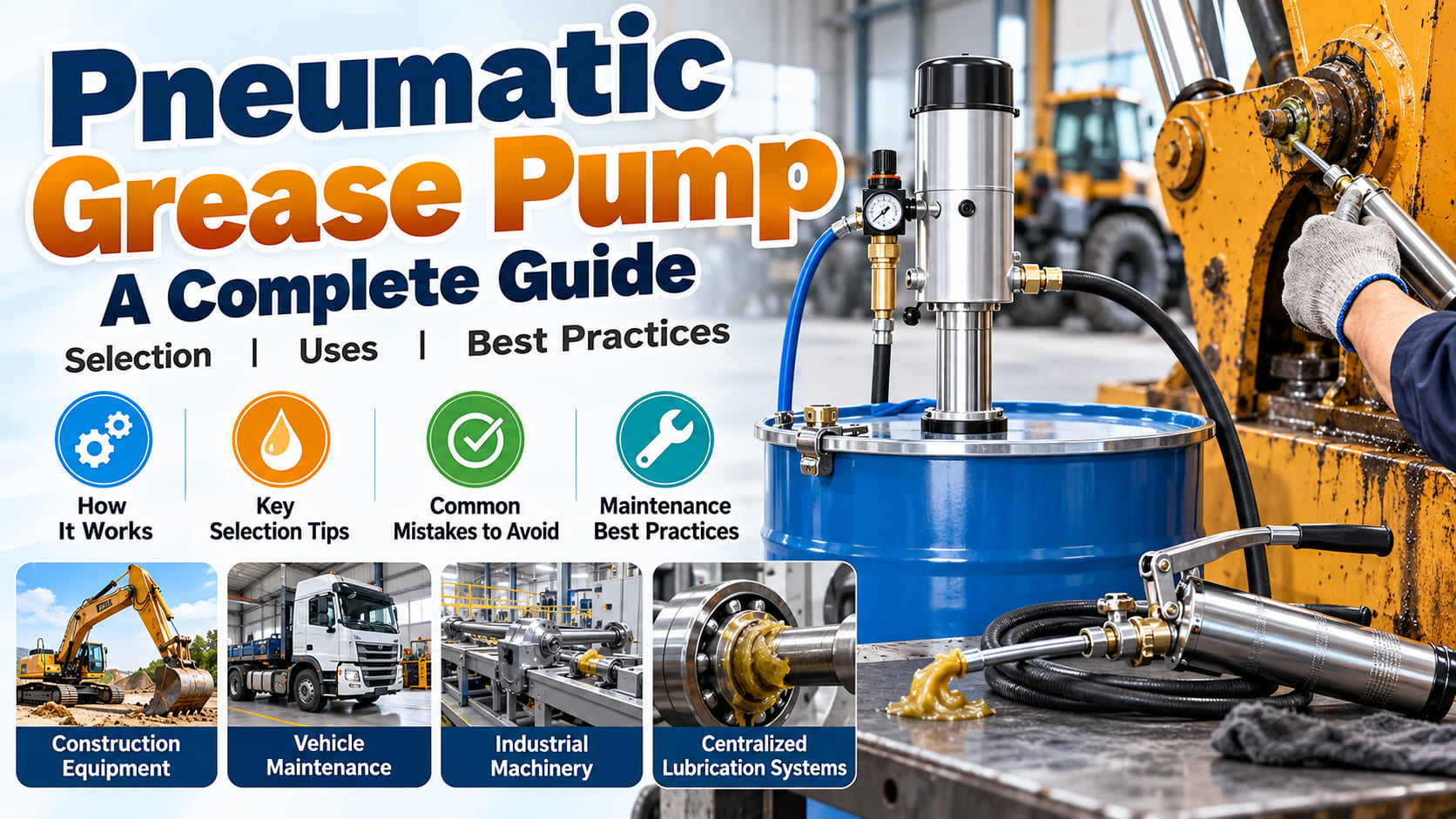
Pneumatic Grease Pump Selection Checklist
| Selection Item | What to Check | Why It Matters |
|---|---|---|
| Grease Type | Consistency, formulation, temperature behavior | Determines pumping resistance and compatibility |
| Container Size | Pail, drum, reservoir, or bulk system | Affects pump tube length and mounting method |
| Delivery Distance | Hose length and number of fittings | Longer systems create higher pressure loss |
| Pressure Ratio | Required discharge pressure versus available air pressure | Must overcome grease and system resistance |
| Air Supply | Air pressure, capacity, cleanliness, stability | Insufficient air reduces pump performance |
| Accessories | Hose, follower plate, reel, gun, trolley, fittings | The entire system must work together |
| Duty Cycle | Occasional, frequent, or continuous service | Influences durability and pump sizing requirements |
Common Pneumatic Grease Pump Mistakes and Problems to Avoid
Many lubrication problems are blamed on the pump even though the actual cause is somewhere else in the system. Avoiding the following mistakes can improve reliability and reduce unnecessary downtime.
- Choosing by pressure ratio alone: high pressure does not compensate for incorrect hose sizing, excessive restrictions, or poor system design.
- Ignoring grease temperature: cold grease can be dramatically harder to pump than grease under normal indoor conditions.
- Using an undersized air supply: the pump may cycle slowly, stall, or fail to reach expected output if air capacity is insufficient.
- Allowing contamination into the drum: dirt and debris can damage pump components and contaminate bearings or other lubrication points.
- Using incompatible hoses or fittings: all components must be suitable for grease service and the expected system pressure.
- Running the pump without adequate grease supply: empty-container operation may cause unnecessary wear or irregular pumping.
- Ignoring pressure before maintenance: residual pressure in hoses and components should be released according to the equipment manufacturer's procedures before service work.
Advanced Tips and Best Practices for Pneumatic Grease Pumps
1. Treat the Pump and Distribution System as One System
A high-quality pneumatic grease pump cannot perform properly if it is connected to a poorly designed delivery system. Hose diameter, total length, number of elbows, swivels, valves, and grease outlets all affect performance. Review the complete flow path when troubleshooting low delivery or slow lubrication.
2. Use a Follower Plate When the Application Benefits From It
A follower plate can improve grease intake by maintaining contact with the grease surface and helping reduce cavities inside the container. It may also keep the container cleaner and reduce grease left on the drum wall. This is especially useful in applications using thick grease or larger containers.
3. Keep Compressed Air Clean and Controlled
Air quality directly affects pneumatic equipment. Moisture, rust particles, dirt, and unstable air pressure may shorten component life or make operation inconsistent. Follow the pump manufacturer's air preparation and lubrication recommendations rather than assuming every pneumatic pump requires the same setup.
4. Standardize Maintenance Procedures
Industrial facilities benefit from a simple inspection routine. Check hoses for wear, fittings for leakage, air connections for damage, grease containers for contamination, and the pump for abnormal cycling or noise. Recording recurring issues can help identify whether the problem is related to lubricant selection, operating conditions, or equipment wear.
5. Do Not Oversize Without a Reason
Selecting the largest or highest-pressure pump available may seem safe, but excessive capacity can increase cost and make system control more difficult. The better approach is to calculate actual requirements and select a pneumatic grease pump with suitable performance margin rather than excessive unused capacity.
Conclusion: Choose a Pneumatic Grease Pump Based on the Complete Lubrication System
A pneumatic grease pump can significantly improve lubrication efficiency in workshops, factories, service centers, heavy-equipment maintenance operations, and centralized lubrication systems. However, successful selection depends on more than simply choosing a pump with a high pressure ratio.
Start with grease consistency, operating temperature, container size, air availability, hose length, delivery distance, flow requirement, and lubrication-point resistance. Then confirm that hoses, fittings, control valves, follower plates, and other accessories are compatible with the complete setup. A properly matched system will usually provide more consistent performance, easier maintenance, and better long-term reliability than a pump selected only by one catalog specification.
Next Step: Before requesting a quotation, prepare the grease type, container size, operating temperature, available air pressure, hose length, number of lubrication points, and expected operating frequency. Providing this information makes it much easier to identify a suitable pneumatic grease pump and supporting accessories.